
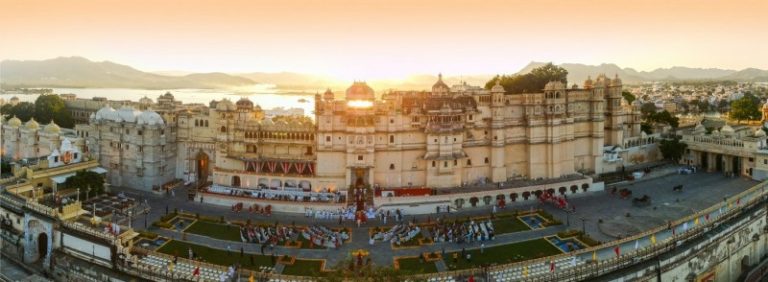
Visitors from around the world gathered at the famous 450-year-old City Palace of Udaipur, India this weekend to witness the historic Ashwa Poojan ‘worshipping the horse’ ceremony. View drone.
The event took place at the Manek Chowk or the palace grounds where the Ashwa Poojan ceremony has been traditionally celebrated, marking the ninth day of the Hindu festival of Navratri.
Widely referred to as both the Venice of the East and the City of Lakes, Udaipur has strong cultural connections to Britain. The city has hosted Her Majesty Queen Elizabeth II and Lord and Lady Louis Mountbatten, while its photogenic landscape and unique palaces and skylines led to the 1983 James Bond film Octopussy being extensively shot in Udaipur. In addition, the city’s museum collections feature numerous British-made pieces, ranging from silver and crystal to vintage cars.
The Ashwa Poojan ceremonial event dates back centuries at the City Palace Udaipur when the Maharanas of Mewar have honoured their horses and elephants with prayers and offerings. This year visitors witnessed the ceremony conducted with solemn piety by the Chairman and Managing Trustee of Maharana of Mewar Charitable Foundation (MMCF) Shriji Arvind Singh Mewar, who is the titular head and 76th Custodian of the House of Mewar, the world’s oldest-serving royal dynasty.Among the first to arrive at Manek Chowk was Shriji’s son, Mr Lakshyaraj Singh Mewar, in traditional Mewari regal attire wearing a pugree or turban and carrying a sword befitting the dignity of the religious occasion. He greeted those present and waited to receive his father at the ceremonial site.

The ceremony began with entry of the Palace Band, with its bagpipers and drummers, leading a procession through the gates of Chandra Chowk into the Manek Chowk palace grounds. The horses were led by an energetic nagara or drum beater. Surrounded by standard bearers, Shriji was seated in a 1905 English Royal Landau Four-in-Hand carriage. As he dismounted, he graciously took a traditional guard of honour.
Along with the senior priests, he then proceeded with the prayer ceremony of worshipping the horses amid chants and ritulas. Each of the rare Marwari horses was dressed in robes, jewellery and guided to the prayer ceremony by their grooms.
The horses participating in the ceremony were Raj Swaroop, Ashwa Raj and Raj Mukut.

The Marwari horse is fundamental to the region’s history. Ballads and songs recount the beauty, bravery, loyalty of this breed over the last 1000 years. The Marwari breed with distinctive inward pointed ears has been revived, from virtual extinction, by the MMCF at its Shikarbadi stables in Udaipur. However, the number of horses is still very few all over the world. Equine experts put the number at 1000.
Shriji Arvind Singh Mewar said: “The horse is an integral part of our living heritage. It is as important for us today to preserve the rare Marwari horse bloodlines as it is to preserve our palaces and temples. From time immemorial horse and man have evolved between them an affinity of not just true companionship but a great deal of trust, respect and deep love. Dedicated to this unique relationship, Ashwa Poojan or worshipping the horse ceremony is our way of paying homage to this bond of eternal loyalty, gratitude and friendship.”
Shriji said the Ashwa Poojan festival is a wonderful event for visitors to see how the living heritage of Mewar is being kept alive at the City Palace; it is a cherished opportunity for tourists to learn about Mewar’s culture while enjoying a heritage holiday.
In his inimitable way, Shriji bridges the past with the present. He said: “The magic of Udaipur is real and not manufactured. You can see it here today drawn from centuries old traditions, culture and civilizational ethos. For the discerning visitors, this is a unique unforgettable experience we offer. Our heritage is not a sculpture carved in the past, al dente and voiceless which time will inevitably grind down and turn to dust; it lives with us and as we live, constantly evolving and thriving to become even more burnished and beautiful with the passing of time.”
Mr Lakshyaraj Singh Mewar said the relationship between Rajputs and their horse dates back centuries.
“We have grown up loving our horses in battle and peace,” he said. “The most famous Rajput horse is Chetak, who achieved immortality in Mewar when he saved the life of Maharana Pratap by carrying him to safety, despite being mortally wounded, at the Battle of Haldighati in 1576 CE. Chetak’s bravery is revered around Udaipur with his own statue, several roundabouts on the city roads carry his name. We remember Chetak today and how his great courage and loyalty is still reflected in the character our beloved Marwari horses.”
A guest from the UK said: “It is a treat to be here at The City Palace. The ceremony, impeccable security and the large-hearted hospitality makes it so special in Udaipur. I have rarely seen such palace events throughout my travels in India.”
The iconic City Palace in Udaipur is the premier attraction in the city drawing million visitors a year. In July 2017 readers of Travel & Leisure magazine voted Udaipur one of the top 15 destinations in the world. The poll was based on sights and landmarks, culture, cuisine, friendliness, shopping, and overall value. Udaipur was the only city in South Asia to make the list.
House of Mewar, Udaipur background
- The House of Mewar is the oldest-serving dynasty in the world dating back to 734 CE.
In the 20th century, the House made one of the most successful transitions in modern India: from a Royal House to one that has clearly defined commercial and non-commercial enterprises, comprehensively preserving the its values, legacies and heritage under the laws of India’s democratic republic.
- Spiritual precepts of the House of Mewar: Bappa Rawal is the founder of the dynasty’s supremacy. Bappa recognized Parmeshwaraji Maharaj Shree Eklingnath ji, an incarnation of Lord Shiva, as the Supreme Lord of Mewar. He received the State of Mewar in trust from his guru, Maharishi Harit Rashi. He thus set a tradition of pious humility and the concept of Custodianship or trusteeship as a form of governance begins with him. In April 1955, Maharana Bhupal Singh created the Shri Eklingji Trust to institutionalise the management of this ancient religious establishment.
www.eternalmewar.in/collaboration/charities/trusts/shri-eklingji/index.aspx
- Shriji Arvind Singh Mewar as the 76th Custodian of the House has demonstrated his commitment, upholding the spiritual precepts as the living heritage of the House. The ambit of the Shri Eklingji Trust has grown and the Temple is now one of the most important pilgrimages of Rajasthan. In honour of Maharishi Harit Rashi, an annual award has been instituted for scholars of Vedic culture and ancient learning by the Maharana of Mewar Charitable Foundation since 1980-81.
- On account of its illustrious history and adherence to values, Mewar was considered the foremost amongst all Princely States of India. Mewar was neither the richest nor the largest of the 565 Princely States of India. In terms of sheer wealth and power, Hyderabad, Mysore, Gwalior, Bikaner and Kashmir were far greater. Yet Mewar was acknowledged as the ‘most respected’ among all Princely States. The respect for Mewar, over the centuries, was the respect for the values and principles it stood for: Honour, independence, self-reliance and a respect for Mankind. The values go back to Vedic times: these are not ‘Indian’ values, as we understand the word ‘Indian’ today. These are ancient values and principles.
- At the time of India’s Independence in 1947, the State of Mewar was the first to amalgamate with the Indian Union. Maharana Bhupal Singh, the Maharana of Mewar in 1947 said, “India’s Independence brings to fulfillment the 1400 years’ struggle and endeavour of my forefathers.”
- With the accession to India, Mewar ceased to exist as a sovereign State. Its economy, polity, administration, judiciary, lands and resources were now merged with, or handed over to, the Government of India. Members of the former Royal families were now citizens of the free democratic Republic of India.
- In the mid-15th century CE, Rana Kumbha (r. 1433-1468 AD) emerged as a Renaissance figure whose Vedic knowledge and military leadership took Mewar to unparalleled heights. He was proficient in the arts, a scholar of scriptures and a man of letters.Kumbha is credited with building 32 fortresses including Kumbhalgarh Fort now a World Heritage Site included in Hill Forts of Rajasthan. Kumbhalgarh Fort has an unbroken wall, 36 km long and is called the Great Wall of India, second only to the Great Wall of China. It is a major tourist spot, just 3 hours’ drive from Udaipur.In honour of Rana Kumbha, an annual award has been instituted for scholars of history and literature by the Maharana of Mewar Charitable Foundation since 1980-81.
- Maharana Kumbha Sangeet Kala Trust, established in 1984 and developed by Shriji Arvind Singh Mewar, promotes and encourages Indian classical music, dances, arts, drama, and other activities of cultural importance as part of the living heritage of Mewar. www.eternalmewar.in/collaboration/charities/trusts/mkskt/index.aspx
- Maharana Pratap (r. 1572-1597 AD) is one of India’s iconic historical figures. He fought for the independence of Mewar against the might of the Mughal Empire and Emperor Akbar. His determination, self-sacrifice and military strategy puts him in a pantheon of mythical, legendary heroes. Four hundred years after his death, Rana Pratap’s life and deeds are recounted in folk stories, songs, popular films and television serials besides works of history and literature.
- In popular lexicon, Rana Pratap’s name has become a pre-fix to the words: honour, valour, bravery, sacrifice and freedom. The closest equivalent would be Mahatma Gandhi of the 20th century.
- In Udaipur today, the international airport, railway station and bus station are named after Maharana Pratap. In 2009, at Shriji Arvind Singh Mewar’s behest the President of India Smt Pratibha Patil unveiled a 15-foot high statue of Rana Pratap at the airport complex. It is probably the biggest statue of the Rana in India today.
- The future King Edward VII, when Prince of Wales, visited India in 1875. The Prince was given a dazzling sarpech (turban ornament) made of three large emeralds and bordered by bands of bright red enamel and diamonds by Maharana Sajjan Singh (r. 1874-1884) and will appear in the Royal Collection exhibition ‘Splendours of the Subcontinent: A Prince’s Tour of India 1875–76’ being held later in 2017 in Bradford and Leicester. See: www.royalcollection.org.uk/collection/11286/turban-ornament
- Maharana Fateh Singh (r. 1884-1930) considered King George V ‘an equal at best’. The story most often recounted is that of the Maharana who ‘refused’ to be a part of the Delhi Durbar of 1903 and 1911. In his own quiet and unassuming way, he made the British realize that Mewar could not, and would not, be equated with any of the other ‘subservient’ Princely States. He knew how to make his point of independence and honour without creating a conflict or controversy. Maharana Fateh Singhji remains an inspiration for all Rajputs till date.Shriji Arvind Singh Mewar, his great-grandson, recounted this story during several events in 2011, commemorating the 100 years of Delhi Durbar of 1911. It struck a chord with many 21st century Indians and foreigners who realized what a demonstration it was of Mewar’s inherent strength and sense of nationalism. In every way, he was an honourable Custodian, upholding the flame of freedom just as his forefathers had done. “For me, Maharana Fateh Singhji remains a quintessential up-holder of India’s dignity and autonomy,” said Shriji.
- Udaipur was visited during Prince of Wales 1921 tour with the future King Edward VIII saying: “There is nothing between Madras and the Northern Passes like Udaipur.”
- Udaipur and the House of Mewar have played host to royal guests and celebrities from all over the world. Queen Elizabeth II and Prince Philip in 1961, Lord and Lady Mountbatten of Burma in 1948, the Duchess and Duke of Kent in 1986 have enjoyed the warmth and hospitality of the Maharanas of Udaipur. www.britishpathe.com/Jacqueline Kennedy’s visit in 1962 is being recalled in the global press even today. www.britishpathe.com/The historian Brian Masters recounted in his book, Maharana, “Queen Elizabeth II was received as a guest at Shivniwas by Maharana Bhagwat Singh. When he naturally offered the Queen precedence, she demurred, saying ‘Please lead the way. You come from a much older family than I do!’”
- The City Palace and Udaipur were the setting for the James Bond film Octopussy in 1983. Maharana Bhagwat Singh took the lead in inviting the famous producers Albert R. Broccoli and Michael G. Wilson to Udaipur, the Lake Palace Hotel and threw open the doors of the new hotel, Shiv Niwas Palace, ahead of time to house the stars. The Indian press recognised the huge multiplier effect which the Bond film was having in Udaipur and Rajasthan.http://indiatoday.intoday.in/story/octopussy-james-bond-comes-to-udaipur/1/392211.html Till date, 33 years after Octopussy release, the film is screened, talked about and often marketed by restaurants claiming ‘the best Octopussy show in town’. http://iwandered.net/2012/03/11/udaipur/
- The Durbar Hall, built during the reign of Maharana Fateh Singhji in 1909-10, was called ‘Minto Durbar Hall’, to honour the visit of Lord Minto, the Viceroy of India. It took 22 years for The Durbar Hall to be completed, it’s an engineering marvel of its times. Today, it’s a glittering exclusive venue for corporate events and celebrations, an integral part of the Fateh Prakash Palace Convention Centre.
- Crystal Gallery is housed in Fateh Prakash Palace. It is the single largest, private collection of crystal anywhere in the world. In 1877, Maharana Sajjan Singh ordered the crystal from the Birmingham-based F & C Osler Company, including objets d’art, furniture, washing bowls, dinner sets, perfume bottles; the Crystal Gallery also houses the only crystal bed in the world. The crystal collection, carrying the crest of the House of Mewar, lay unpacked in cartons for almost 60 years before the present Custodian, Shriji Arvind Singh Mewar curated and developed the Crystal Gallery.
- Udaipur’s climate: Mild summers (30 degrees C to 40 degrees C); mild winters (11 degrees C to 28 degrees C). Clothing required: Light tropical in summer, carry hats and anti-sun lotions; Light woolen in winter. Accessories: Come armed with cameras and shoot to heart’s content in photographers’ paradise. Languages spoken: English, Hindi, Mewari. Best time to be there: September to April.
How to get there:
Nearest international airports: Ahmedabad, Jaipur, Delhi and Mumbai.
Flights: Daily flights from New Delhi (flight time: 1 hr. 10 mts.), Mumbai (1 hr. 30 mts), Ahmedabad (45 mts.), Jaipur (45 mts.).
Rail: Convenient daily trains from New Delhi, Mumbai, Ahmedabad and Jaipur.
Bus: Air-conditioned coaches to and from New Delhi, Mumbai, Ahmedabad and Jaipur.
Road: 637 km from Mumbai, 250 km from Ahmedabad, 405 km from Jaipur, 664 km from Delhi