
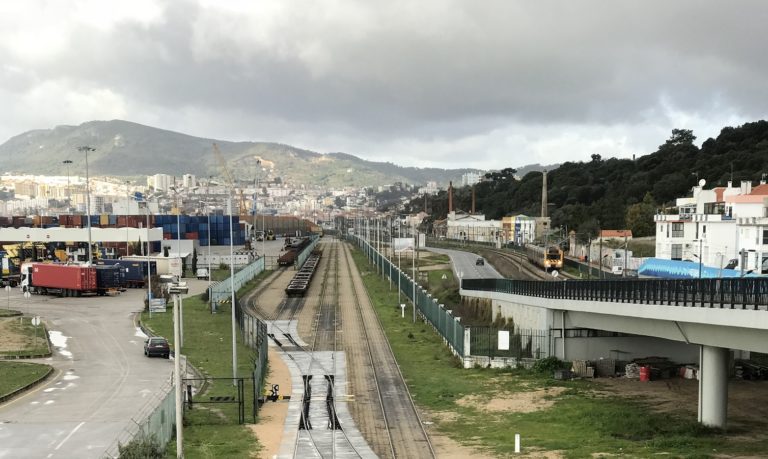
A new €500million rail project stretching across Iberia is set to transform Portuguese maritime trade and export, according to Blue Atlantic Industrial and Logistics Park.
The 94-km Évora-Elvas-Caia rail line will complete a ‘missing link’ between the Portuguese interior and Spain, creating a high-speed freight train connection to ports including Setubal and Sines.
Blue Atlantic project lead Fernando Fernandes, based in Setubal, said the investment will create a new ‘international trade corridor’ connecting Portugal to the rest of Europe unlike ever before.
A public tender for track construction was launched this month at a special event in Elvas – attended by Portugal’s Prime Minister and his Spanish counterpart Mariano Rajoy, along with the European Commission’s head of transport Violeta Bulc. Work is expected to begin in March 2019 and completed by early 2022.
“This news comes as a major boost to Portugal’s port and maritime sector,” said Mr Fernandes. “It will provide faster, easier and better access from key ports such as Setubal and Sines to distribution centres in the heart of Europe. It also greatly improves conditions for private investment, internationalisation and the export of products and services.
“Portugal is pole position for Atlantic trade on the western edge of Europe along major global shipping routes. Ports like Setubal, where Blue Atlantic is based, just 40km south of Lisbon, offer one of the fastest and most efficient routes in and out of Europe. A key benefit to importers and exporters is they can bypass the congested Mediterranean.
“Investment in the Évora-Elvas-Caia rail line will revolutionise on-land freight transportation from Portugal to Spain, which is a major advantage to Setubal being the second closest port to Madrid. Furthermore, it will create a new southern corridor to wider Europe, making Portugal even more attractive from an exports perspective.”
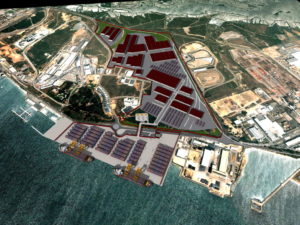
The news comes weeks after Blue Atlantic released plans for an 800metre quay showcasing its formidable maritime trade potential. The 96-hectare site based in the Mitrena Industrial Zone and is being offered for sale by Portuguese holding services company Sapec.
Mr Fernandes said the Évora-Elvas-Caia rail plan is symbolic of the fortunes for the Portuguese economy. In 2017, public investment in Portugal increased by 20pc, and is set to rise to 40pc in 2018. Major investments will be made to health, education and infrastructure in a bid to drive national productivity.
“For years industry professionals have been calling for more capital spend to unlock trade links across Iberia,” he said. “It’s a hugely positive step and a necessary measure for Portugal to remain relevant in a fast- changing world. In order to attract foreign investment and encourage private sector growth we must make our trade conditions as favourable as possible. Portugal has exceptional natural assets, an enviable location and a strong seafaring and export heritage, meaning it is perfectly geared towards international trade.
“This latest investment to our rail network is a major boost to Blue Atlantic Industrial and Logistics Park. We have a firm vision for the site which is currently a very large, empty plot of land with huge potential. It has all the ingredients for developer to create a world class multi-modal export hub. It has capacity to build a private railway on site which could operate trains up to 750m in length linking to the international rail network.
“We recently demonstrated the site’s maritime potential with plans for an 800metre which could accommodate multi-purpose vessels including containers, bulk and cargo carriers. Now there is firm EU-level backing to boost on-land transport links making pan-European trade even easier. We believe Blue Atlantic offers an ideal location for any importer or exporter looking to harness the full trade potential of the Iberian Peninsula.
The Port of Setubal is a world-renowned maritime export hub with several specialized terminals operated by private enterprises including Sadoport, TERSADO, AutoEuropa and Sapec for handling break bulk and general cargo, RO-RO, solid and liquid bulks and containers.
It is home to three of Portugal’s top four exporters and some of the region’s largest international enterprises including Volkswagen Autoeuropa, MEGASA (ex-Siderurgia Nacional) steel company, Navigator Papermill, GE factory and Sapec chemical and fertilizer industries.
For more information contact Blue Atlantic on Phone: (+351) 265 710 253 mobile: (+351) 96 322 49 71 E-mail: geral@blueatlantic.pt
Notes to editors
Blue Atlantic Industrial & Logistics Park
-
- Blueatlantic Industrial & Logistics Park is a 96ha site located in the Mitrena Industrial Zone, Setubal, 40km south of Lisbon, Portugal.
- It is being offered for sale by Portuguese industrial and holding services company Sapec.
- It’s position on the Atlantic Ocean is ideal for exporting along global shipping routes combined with direct road and rail connections to mainland Europe, meaning vessels don’t have to enter the Mediterranean.
About the site
- The site has regular orography with mild slopes which facilitate earth movements.
- It has a 380,000 metre2 maximum construction capacity and the following infrastructures already in place: low and medium-voltage power networks, lighting and optic fibre communication networks (voice, data and CCTV), treated household and industrial effluents, with connection to Cachofarra sewage treatment plant, drinking water and fire extinguishing networks, natural gas network and rainwater network with retention and flood control equipments.
- The Port of Setubal offers many commercial incentives. It is sheltered with calm waters and a temperate climate with 300 days of sunshine a year.
- The port never closes ensuring maximum operational efficiency. Its sandy and stable river bed is also easy to modulate making maintenance cheaper than neighbouring harbours.”
The Setúbal Peninsula
- The Mitrena Industrial Zone is a large and strategically advantageous industrial zone.
- It comprises of a large shipyard, cement and paper mills, chemical and fertiliser industries, metal working facilities and an industrial waste treatment plant and many other facilities.
- The region’s leading international businesses include Volkswagen Autoeuropa, MEGASA (ex-Siderurgia Nacional) steel company, Navigator Papermill, GE factory and Sapec chemicals and two big fertilizer industries.
- The Setúbal Peninsula has a very lively economy based on the sea, a factor that has led to the formation of a specialised workforce for the sector and for different industrial purposes. The majority of professional training courses are located on the Peninsula and are in line with this economic purpose.
- Made up of nine councils with an area of more than 1,400 km2, it has good demographic indicators. According to recent data from 2013, it has about 82,000 people and 49%pc of the population is economically active.
Companies located in Setubal:
- Volkswagen Autoeuropa – 1606million turnover
- Navigator (Portucel) – 1531million turnover
- SAPEC – 474million turnover
- Megasa (Siderurgia Nacional) – 468million turnover
Portuguese economy
- With a population of 10.4 million within an area of 92 thousand km2 (approximately 35.5 thousand mi2), Portugal has a GDP of 16,200 euros per capita. About 15pc of the national population has a higher education and the country’s labour force is well regarded for its high quality.
- A distinctive factor noted in the Portuguese workforce is its entrepreneurial ability, as observed in the emergence of countless start-ups that have transcended borders from all parts of the country.
- The Portuguese economy is diversified and almost all industries are strongly driven to export. Exports represented 42% of the GDP and keep growing, with special emphasis on industrial supplies, consumer goods, transport material and accessories, machinery, food and drinking products, as well as fuels and lubricants.
- Some products take the Portugal brand and its special quality label worldwide, as in the case of wine, processed tomato, footwear, cork and olive oil. These last two products have a greater relevance: Portugal is the largest cork exporter and it occupies the 3rd position in the ranking of olive oil exports throughout the world.
- The main trade partners are based in Europe, namely Spain, France, Italy, United Kingdom and Germany. However, there was an increase in business relationships with the CPLP countries (Community of Portuguese Speaking Countries) – which form a market of 250 million consumers. In this regard, Angola and Brazil still hold the highest volume of commercial trade with Portugal.
- The Portuguese language represents an important factor for the economy. It is the fifth most spoken language in the world and the sixth most used language in business.
- ISCTE – Instituto Superior de Ciências do Trabalho e da Empresa – conducted a study which revealed that business activities related to Portuguese language countries represent 17% of Portugal’s GDP
National Highways
- Portuguese national highways rank number one in Europe and number two worldwide behind the United Arab Emirates.*Data from the World Economic Forum.
Port Sector
- The seven main Portuguese ports handled 82.5 million tons in 2014, with a growth of 4%. These figures are largely due to the port of Setúbal, one of the country’s most strategic ports. *Data from the IMT – Institute of Mobility and Transport.
National Railway System
- The railway sector is a key priority for government investments throughout the national territory, especially the connection between Sines and Spain. *Data from the Working Group for Added Value Infrastructures (GTIVA)
Exclusive Economic Zone
- Portugal has one of the longest maritime coasts in Europe, with 942 km. Its EEZ– Exclusive Economic Zone – is the 3rd largest in the European Union (representing 11% of the total) and 11th largest in the world. But there are plans to expand this economic zone, which currently extends to a limit of 200 miles of territorial sea, to cover 350 miles, which will make it the 10th largest in the world.
- The sea is seen as a “national plan for the future” and the country’s strategy now is to promote maritime transport, naval construction, fishing and fish processing, among other activities. *Source: Banco BPI.
20th Tourism Destination Worldwide
- Tourism is a strategic sector for Portugal. According to recent data, the country received more than 20 million visitors, making it the 20th tourism destination on the planet, according to the Travel & Tourism Competitiveness Index.
- A study carried out by Portugal Tourism reveals the criteria that most affect tourists’ decision to visit the country: Climate, beaches, safety, scenery, cuisine, hospitality, cost, attractions, entertainment, events and infrastructures.