
Plans to build Britain’s official national monument to the Battle of the Atlantic on Liverpool’s waterfront have won top-level support in the United States.
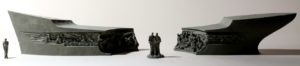
The Battle of the Atlantic Memorial campaign (BOAM) launched its effort to build the £2.5million 15 ton sculpture, in the shape of a Liberty ship split in two, in January. And as a result of the publicity it has now received offers of help from two significant American organisations the American Merchant Marine Veterans (AMMV) and Project Liberty Ship in Baltimore, Maryland.
BOAM chairman Vice-Admiral Mike Gretton said both organisations reached out after the campaign announced it has received support from British Ambassador to America Sir Kim Darroch for an awareness raising tour to the USA in the autumn.
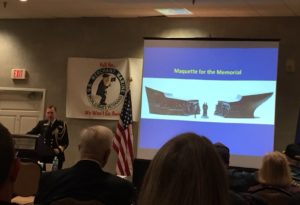
“We are absolutely delighted to make contact with both the AMMV and Project Liberty Ship and see our campaign start to generate momentum,” he said. “An immediate result is that the British naval attache to America Commodore Martin Connell gave a presentation, on our memorial plans, to the AMMV’s annual convention in St Louis, Missouri on March 17. We are hugely grateful to the AMMV for giving us this opportunity to raise awareness.”
“It is further very helpful to receive support from Martin and the British Embassy in Washington. The American and British merchant navies fought tirelessly throughout the Battle of the Atlantic and suffered horrendous losses. The American intervention was critical to the outcome of the war and it is precisely the efforts of the merchant navy that we want to highlight in our memorial. In that sense our objectives and those of the AMMV and Project Liberty Ship are very closely aligned.”
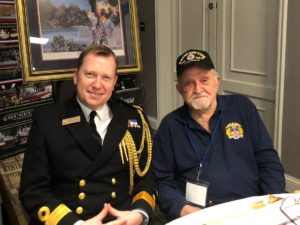
Commodore Martin Connell, British naval attache to the United States said: “It was a privilege to be invited to join the U.S. Merchant Marine veterans at their annual convention. There was universal support for the plan to build a lasting and fitting memorial to the Battle of the Atlantic in Liverpool – a place where many of them had visited during WWII. I was particularly struck by the remarkable experiences of the veterans, and it was a delight to talk with them all.”

Captain Christopher J. Edyvean, AMMV National President said:
“The American Merchant Marine Veterans (AMMV) organization is pleased to have established contact with representatives from the Battle of the Atlantic Memorial. We at AMMV stand ready to help spread word of the BOAM project, as we believe the proposed monument would help future generations learn of the great sacrifice and service of Allied Merchant Marine and Merchant Navies. In addition, we were delighted to have Commodore Connell join us at our 32nd National Convention in St. Louis.”
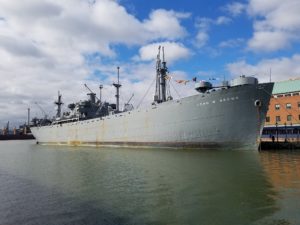
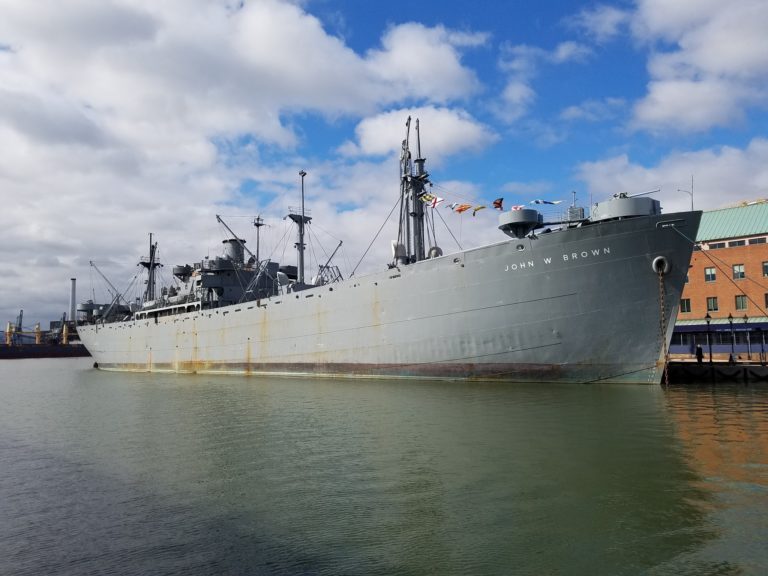
Vice-Admiral Gretton said it is of enormous value to the campaign to make contact with Project Liberty Ship. The project operates and preserves the SS John W Brown Liberty ship as a living memorial to the incredible impact of the Liberty fleet, cargo ships built to replace those being torpedoed by Nazi U-Boats. It highlights the role of three groups during the Battle of the Atlantic: the American Merchant marine, shipbuilders and the Naval Armed Guard. In total, 2710 Liberty ships were built at 18 American shipyards between 1941 and 1945 fundamentally changing the course of the battle and the war.
“We are in early talks with Project Liberty Ship about how we can work together long term to share educational resources,” he said. “We know for our supporters in Liverpool and around the UK, the work of Project Liberty Ship will be of tremendous interest. We see huge potential for partnership promoting the Battle of the Atlantic infrastructure in Liverpool namely our memorial, the newly transformed Western Approaches museum, the British command headquarters, and the Battle of the Atlantic exhibition at the Mersey Maritime Museum. The Battle of the Atlantic was fought shoulder to shoulder with America and it is fitting we should work together to commemorate the campaign with likeminded organisations in the US. We look forward to meeting with both Project Liberty Ship and the AMMV when we visit America in the autumn for our awareness raising tour.”
Project Liberty Ship Chairman, Hugh Cadzow said it is excited to learn of the BOAM campaign and is honoured that the silhouette of the monument is to reflect that of a WWII merchant vessel.
“We enthusiastically support BOAM in commemorating the longest and most overlooked battle of World War II,” he said. “Educating younger generations about the civilian merchant mariners and the military gun crews as well as memorializing their service is the basis for our existence. Supporting one another to make sure our collective message is heard on both sides of the Atlantic is absolutely necessary. We look forward to working side by side with BOAM, AMMV and other sister organizations in promoting this long overdue tribute.”
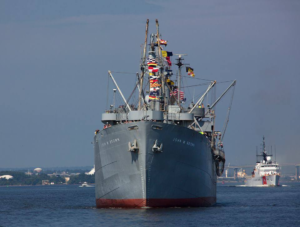
BOAM’s awareness raising tour of America is planning events at the British Embassy in Washington as well as consulates including Chicago, New York, Boston, Atlanta and New Orleans.
Vic- Admiral Gretton said BOAM is actively looking to work with all countries who took part in the Battle of the Atlantic and is in discussions with a wide range of embassies and ambassadors.
“Our memorial will be an international monument to peace and learning,” he said. “We are at the very beginning of our campaign but we want to partner with other memorials and museums around the world who share our focus on the Battle of the Atlantic. It is very pleasing to see such interest in our memorial already which reflects our belief that the time is right to have a national Battle of the Atlantic Memorial in Britain remembering the 100,000 people who died from all over the world and thousands more who served and survived.”

For more information on the campaign, sponsorship packages and to make donations visit: www.battleoftheatlantic.org email: info@battleofatlanticmemorial.org call: 01243 545939 Twitter: @BattleAtlantic Note: overseas donations must be made by cheque
Notes to editors
- Campaign background
The Battle of the Atlantic Memorial (BOAM), is a UK charity. It launched the campaign to build the memorial in January 2018 at a press conference in Liverpool attended by BOA veterans.
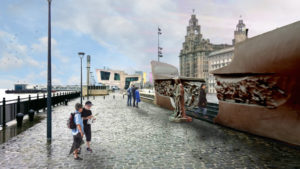
At the press conference the campaign unveiled a design by acclaimed sculptor Paul Day for 28 metre 15 ton monument in the shape of a merchant ship split in two. The memorial will incorporate the existing statue of U-Boat hunter Johnnie Walker. Paul Day’s works also include the Battle of Britain Monument and the Iraq-Afghanistan memorial, both in London.
The campaign is aiming to unveil the monument in 2019, the 80th Anniversary of the start of the battle and the beginning of World War Two.
The memorial will work closely with Merseyside Maritime Museum and National Museums Liverpool to highlight the project and develop educational projects reinforcing just how fundamental the Battle of the Atlantic was to the war effort. The memorial will also be sited on National Museums Liverpool’s land, between the River Mersey and the Museum of Liverpool.
Sculptor Paul Day said the proposed BOA monument is set to be his largest to date.
“It’s a huge honour and privilege to be involved in this project,” he said. “The Battle of the Atlantic presents such a fertile, thrilling and challenging set of historic circumstances to work with. Despite the ravages of war Liverpool remains a breath-taking city and one of the greatest waterfront skylines in Europe. This sculpture must be able to complement a varied architectural landscape and balance while having a strong visual impact to honour the immense sacrifice of those who fought in the battle. The plan is scaled at around 28 metres across and four-and-a-half metres at the highest point. Each half of the two-piece structure is likely to weigh between 10 and 15 tons. They will be hollow with a stainless-steel armature and bronze cladding. Scale is obviously critical to the impact of a piece in a landscape, which in this case is dominated by Liverpool Museum and the large distances of space which separate one end of the old historic docks to the new dock. Liverpool Museum will be used as a backdrop to create a silhouette evoking the image of liberty ships and commercial maritime vessels. This is an important design feature reflecting the nature of the battle to forge a safe passage for our merchant vessels across the Atlantic. The dual sections will enable the public to walk through and interact with messages and scenes portrayed in friezes along the sides.”
Backing the plans for the memorial in January British Ambassador to America Sir Kim Darroch said:
“Keeping the North Atlantic open to British and American shipping is as important now as it was 75 years ago at the height of the Second World War. At that time, the North Atlantic shipping channels were a vital lifeline, without which the war could not have been won. So it is entirely fitting that a campaign should have been launched to raise the funds to build a UK memorial to the brave and selfless men and women who were wounded or sacrificed their lives in the Battle of the Atlantic. I am delighted that the Battle of the Atlantic Memorial Fund are visiting the US to promote this worthy cause.”
- Battle of the Atlantic factfile
“The Battle of the Atlantic was the dominating factor all through the war. Never for one moment could we forget that everything happening elsewhere, on land at sea or in the air, depended ultimately on its outcome.”—Winston Churchill
The Battle of the Atlantic was the longest campaign of World War Two. It began on September 3 1939 and lasted until VE Day May 8 in 1945, in total five years eight months and five days. The cost of the battle was extremely high for both sides. It is impossible to be sure how many died but an estimated 26,500 British merchant seamen were killed while the Royal Navy lost more than 23,000 seamen. The allied war dead of naval and merchant seaman is estimated at more than 20,000 from Canada, USA, India, China, Poland, Norway, Holland, Greece, Belgium, South Africa, Australia, New Zealand and Russia. In total around 3,500 merchant ships were sunk and 15 million tons of allied shipping was lost. Many thousands of civilians were also caught in bombing raids at ports and shipyards on both sides of the Atlantic. In Liverpool, for example, the ‘May blitz’ of 1941 saw 1,746 Merseysiders killed and 1,154 injured in eight nights of bombing. Meanwhile, the U-Boat memorial near Kiel has the names of 28,000 crewmen who died, more than 60pc of those who served. Of the 859 U-boats 648 were lost, across all seas in which U-Boats operated. Statistics from Royal Navy Historical Branch and Battle of the Atlantic, Andrew Williams, BBC books.
The Battle of the Atlantic’s core was the Allied naval blockade of Germany, announced the day after the declaration of war, and Germany’s subsequent counter-blockade. It was at its height from mid-1940 through to the end of 1943. The Battle of the Atlantic pitted U-boats and other warships of the Kriegsmarine (German navy) and aircraft of the Luftwaffe (German air force) against the Royal Navy, Royal Canadian Navy, United States Navy and Allied merchant shipping. The convoys, coming mainly from North America and predominantly going to the United Kingdom and the Soviet Union, were protected for the most part by the British and Canadian navies and air forces. These forces were aided by ships and aircraft of the United States beginning September 13, 1941. The Germans were joined by submarines of the Italian Royal Navy (Regia Marina) after their Axis ally Italy entered the war on June 10, 1940.
As an island nation, the United Kingdom was highly dependent on imported goods. Britain required more than a million tons of imported material per week in order to be able to survive and fight. In essence, the Battle of the Atlantic was a tonnage war: the Allied struggle to supply Britain and the Axis attempt to stem the flow of merchant shipping that enabled Britain to keep fighting. From 1942 onwards, the Axis also sought to prevent the build-up of Allied supplies and equipment in the British Isles in preparation for the invasion of occupied Europe. The defeat of the U-boat threat was a pre-requisite for pushing back the Axis. The outcome of the campaign was a strategic victory for the Allies—the German blockade failed—but at great cost: 3,500 merchant ships and 175 warships were sunk for the loss of hundreds of U-boats.
The name “Battle of the Atlantic” was coined by Winston Churchill in February 1941. It has been called the “longest, largest and most complex” naval battle in history. It involved thousands of ships in more than 100 convoy battles and perhaps 1,000 single-ship encounters, in a theatre covering millions of square miles of ocean. The situation changed constantly, with one side or the other gaining advantage, as participating countries surrendered, joined and even changed sides in the war, and as new weapons, tactics, counter-measures and equipment were developed by both sides. The Allies gradually gained the upper hand, overcoming German surface raiders by the end of 1942 and defeating the U-boats by mid-1943, though losses due to U-boats continued until war’s end. (Source Wikipedia)
The final victory in the Atlantic was assured by the American entry to the war. The USA was able to bring overwhelming military and industrial muscle to the campaign with formidable contributions from the US Navy and its Hunter Killer Task Groups. Furthermore, the rapid production of merchant ships in the USA, mainly Liberty ships, was a key factor in the balance between those sunk and new replacements. Canada too played a key role, by the end of the war it had more than 400 ships, almost half the North Atlantic escort force, an extraordinary contribution from a country that could only boast six warships in 1939. In total, 1,600 Merchant Navy personnel from Canada and Newfoundland were killed. one out of every seven Merchant Navy sailors who served was killed or wounded. The RCN and RCAF paid a high toll in the Battle of the Atlantic. Most of the 2,000 RCN officers and men who died during the war were killed during the Battle of the Atlantic, as were 752 members of the RCAF
In 2013 Battle of the Atlantic events were staged in Liverpool, Londonderry and London to commemorate the 70th Anniversary of the Battle. The Ministry of Defence made clear those events would be the final official commemoration of the BOA, hence the need for a permanent memorial.