Flexible, fast and watertight – how Roxtec cable and pipe transits are helping to futureproof the cruise ship industry. This article first appeared in the Naval Architect.
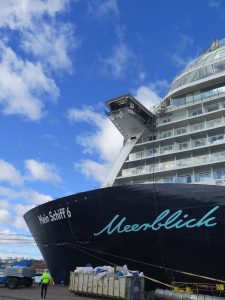
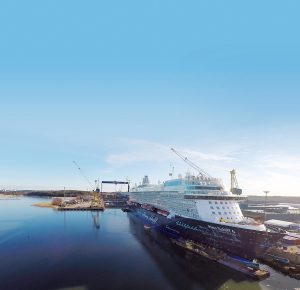
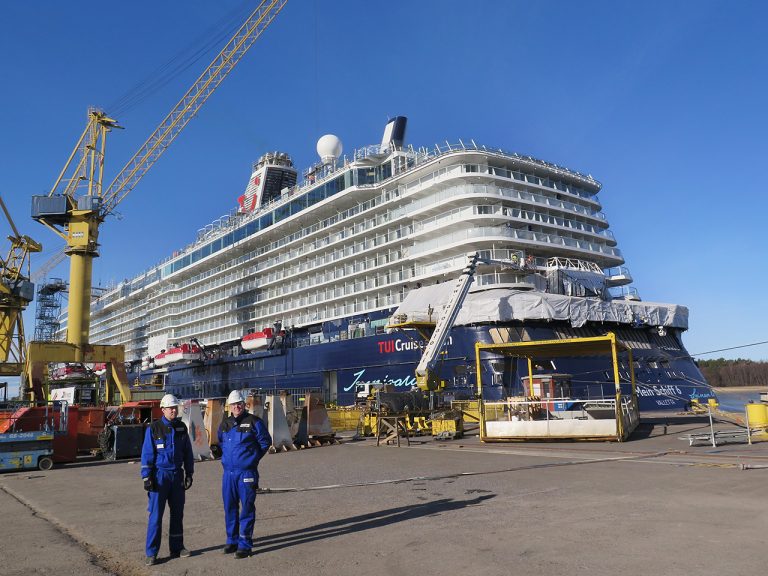
When faced with sealing over 6,000 openings for cables and pipes, the builders of TUI’s cruise ship Mein Schiff 6 opted for the Roxtec system. This relatively simple invention was used to great effect on the 98,811 GRT ship, not only greatly reducing the fitout time, but also adding redundancy for future upgrades.
The biggest challenge when faced with running pipes or cables through structural metal partitions is to make a seal that is totally secure. Each one has to be watertight, gas tight and fire-resistant. Traditionally, this has been done by cutting a hole to the exact diameter of each metal conduit and then welding them into place. This presented several problems, ranging from manipulating intense heat in a confined space to how to remove the pipe again for repairs or modifications.
In the cruise ship industry, deck and bulkhead penetrations have to cater for a wide range of non-ferrous carriers too – from lightweight plastic pipes for domestic services to antenna feeds and fibre-optics. High power electrical cables can give additional problems of electromagnetic interference. Making thousands of holes and welds – and then remaking them for upgrades or new technology – is labour intensive and costly.
The answer arrived in 1990, when Swedish inventor Mikael Blomqvist developed his idea for a flexible, low cost fireproof seal and built the first versions in his residential garage. The concept took off and the company he founded, Roxtec, has since grown to a turnover of $US 200 million and the employment of around 800 staff. Roxtec products are now used on a wide range of installations needing dependable seals, from oil rigs to nuclear power plants.
As technology evolves, particularly in the environmental and propulsion sectors, pipes and cables can be altered and re-routed without major cutting or welding operations. This effectively futureproofs a ship. The Roxtec system also allows for additional conduits to share an existing seal with simple modifications. A key advantage is the speed of installation for the cruise ship industry along with the built in redundancy that can be added for future upgrades.
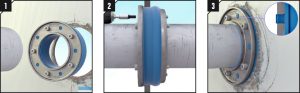
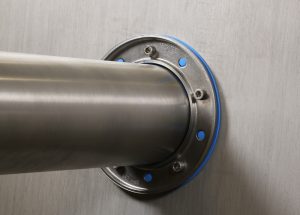
The company’s latest concept, the Roxtec SPM seal, was to eliminate welding completely and instead support the pipe in a sandwich made of a seal ring of EPDM (Ethylene Propylene Diene Monomer) rubber. This was mounted between two flanges of marine-grade stainless steel, the inner diameter aligns with the most common pipes sizes.
“All you need to do is cut a circular hole in the bulkhead to a prescribed diameter,” explained John Kayes, Marine and Offshore Director for Roxtec UK. “Then just clean it up, remove the sharp edges and you are good to go. The opening doesn’t even have to be a perfect circle as there is sufficient flex in the Roxtec SPM seal. This greatly simplifies installation, plus any maintenance work and even repairs at sea. When using our SPM seals, engineers at a Brazilian shipyard cut installation time by a remarkable 88% and the associated installation costs by 50%. Another job had been assessed as requiring 5 people, including a painter, a total of 100 hours using welding techniques. That was reduced to just 2 people and 12 hours using SPM seals.”
On the 295m Mein Schiff 6 over 100 installers were working with Roxtec seals throughout the ship, from the engine room to the pool area. Many of the transits were for lightweight plastic pipes, which presented challenges in terms of fire proofing. Roxtec has always focussed on the integrity of its products and recently developed a new test facility within its headquarters in Karlskrona, Sweden. Here, each prototype seal is placed in a section of bulkhead and subjected to full-scale stressing, especially with fire. The data is captured in real time and there is even a viewing area for interested parties to witness events.
Another helpful innovation for ship builders is the Roxtec Transit Registry, where all the onboard pipe and cable penetrations are digitally logged so the customer can keep track of them. The registry collates all the original penetrations, any upgrades, and also stores the necessary certifications.
For the Mein Schiff 6 project, key managers found it easy to source the products they needed from one supplier, especially as each design comes with international documentation. At the last count, there were more than 250 registered product certificates and 500 registered approvals.
“The most important thing is to keep up the speed by handling fewer items,” said Mika Tuokko, head of electrical outfitting for the ship at Meyer Turku. “By using Roxtec instead of other systems we avoid 50 items in stock for each transit.”