
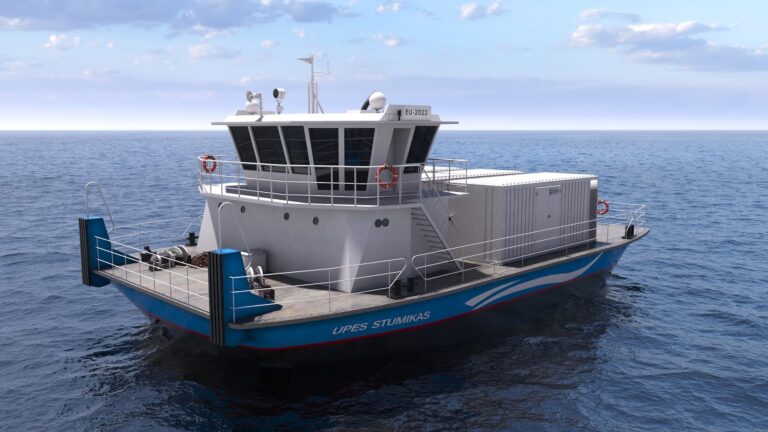
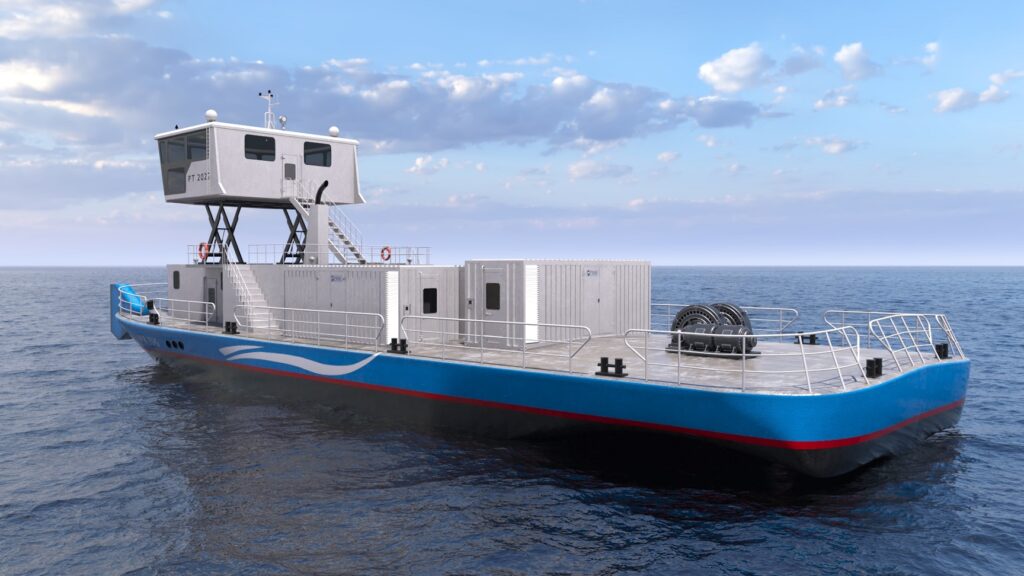
Lithuanian ship designer Western Baltic Engineering (WBE) is to unveil two new models of its groundbreaking electric ‘pusher’ vessel series, known as the ELECTRIC EEL, at the Work Boat trade fair in New Orleans in a drive to help America’s vast inland waterways network to decarbonise.
The vessels are the latest editions to the first series of battery powered ‘pushers’ ever designed. Known as EE20 and EE26 the latest vessels are being adapted from the original model EE27 launched by WBE in August. They offer different functionality including the ability to ‘pull’ as well as greater power and range capabilities.
WBE’s senior sales manager, Chris Cowan says the vessels are being launched at Work Boat as they are suited to much of America’s extensive inland waterways network which is under greater pressure to reduce emissions under US Environmental Protection Agency (EPA) regulations and IMO GHG targets. He pointed to research from ABS (see notes to editors 1) which estimates that aging vessels on the US inland waterways emitted 5.67 billion kilograms of CO2 in 2018 from around 4,000 towboats, hauling 25,000 barges and carrying 630 million tons of cargo along 25,000 miles of waterway every year.
“We are really pleased to launch these latest designs at Work Boat,” he said. “We see huge potential for the vessels to be designed in Lithuania and then built at US yards. We have adapted our design in response to market demand in Europe following the EE27’s launch in August this year. The EE27 is set to be built for the Lithuanian Inland Waterways Authority next year. But to operate on the Danube and Rhine we recognised the design needed to be adaptable particularly for the deeper waters than on Lithuania’s inland waterway network. With a greater depth and range capability the designs can operate in the deeper rivers around America, plus they fit with the US drive to switch to more electric propelled craft.”
Chris said the Electric Eel concept is capturing barge operators imagination.
“We’ve had a terrific response since launching the EE20,” he said. “But some operators wanted different functionality. As a result both the EE20 and EE26 models are being innovated to meet specific customer requirements. Notably both can operate in deeper water, with a 2.5m and 2.6m draft respectively compared to 1.2m for the EE27. In addition, both new vessels have greater power with four TEU size battery containers being installed instead of two, enabling range capacity to be boosted from 300km to 375km while the EE26 can push or pull two 1600 tonne barges and the EE20 can push 2500 tonnes compared with 2000 tonnes on the EE27.”
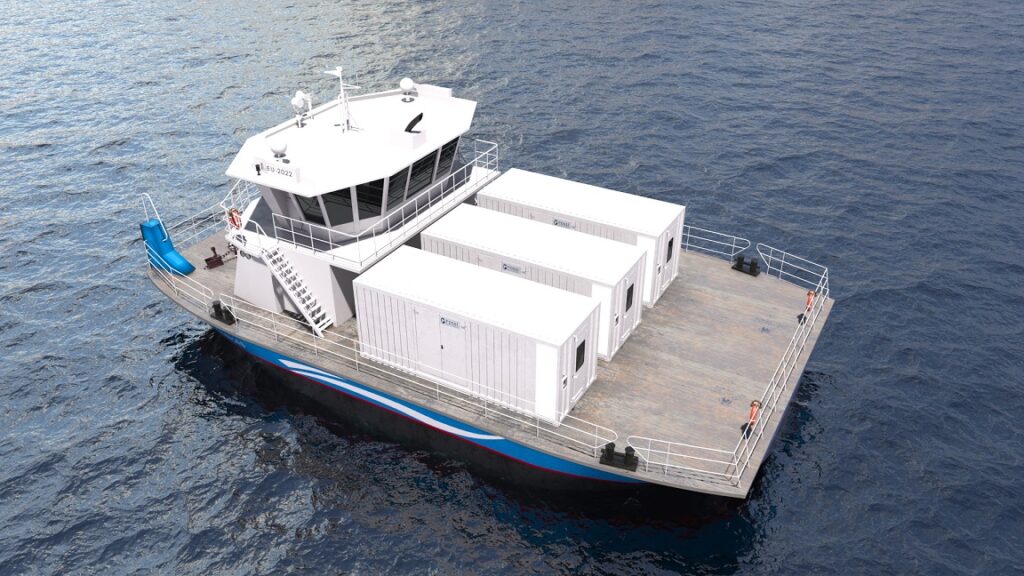
Chris said the EE26 is the most radical departure in the series yet as it will offer a ‘pull’ as well as ‘push’ function to manoeuvre non propelled barges. As a result of the design innovations all models will now operate on a methanol back up generator which can completely replace or supplement the battery power as required and offers a safe return to port solution.
The ELECTRIC EEL series of vessels are designed to replace diesel pushers which presently dominate the market for ‘pushing’ non-propelled barges around inland waterways. Pressure is further increasing from the European Union which wants to shift freight to Europe’s Inland Waterways via more green powered vessels (see notes to editors). On the Danube alone there is a fleet of 332 diesel pushers pushing more than 2000 non-propelled barges.
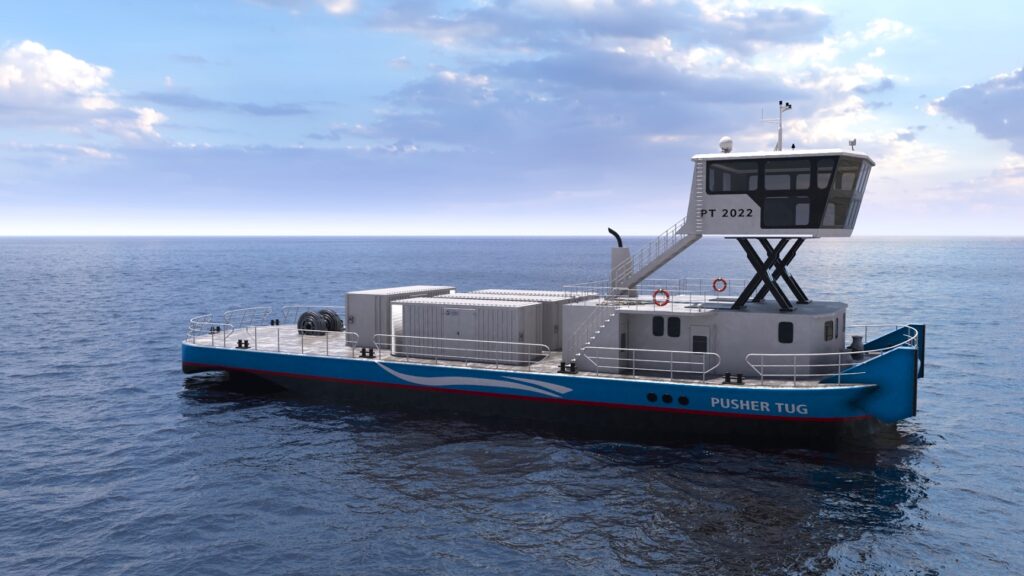
The ELECTRIC EEL series will operate on batteries designed by Andorra based AYK Energy which recently signed a design partnership with WBE. AYK president Chris Kruger confirmed the new partnership will focus on deploying its Aries + model 17.6 KW hour li-ion batteries with the potential to expand to its 23.3 KW hour Centarus & Aquarius ranges.
Notes to editors
- Read ABS inland waterways report https://absinfo.eagle.org/acton/attachment/16130/f-b4e7743c-3141-4f2a-98a6-734bcc81a5a2/1/-/-/-/-/decarbonization-of-the-inland-waterway-sector-in-the-united-states-september-2021.pdf
2 ELECTRIC EEL series specifications
EE20
| Beam | 11 m |
| LOA | 20 m |
| Max Draft | 2,5 m |
| Speed downstream | 12 |
| Speed upstream | 10 km/h |
| Air draft (min-max) | 7m / 12m |
| Range | 375km |
| Pushing/pulling capacity | 2500 |
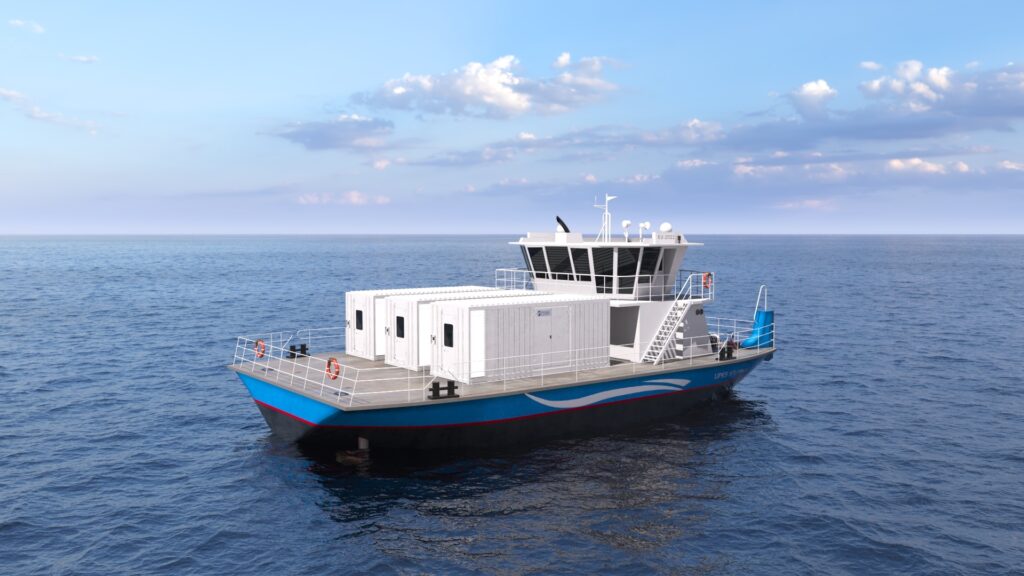
EE26
| Beam | 9,2 m |
| LOA | 26 m |
| Max Draft | 2,6 m |
| Speed downstream | 12 |
| Speed upstream | 10 kmh |
| Air draft (min-max) | 5.5m /11.5 m |
| Range | 375 |
| Pushing/pulling capacity | 2x 1600 ton barges |
EE27
| Beam | 9,2m |
| LOA | 27,35m |
| Max Draft | 1,2m |
| Speed downstream | 12 kmh |
| Speed upstream | 10 kmh |
| Air draft (min-max) | 6m |
| Range | 300 km |
| Pushing capacity | 2000t barge/90TEU |
All three designs will also deploy a wind turbine to generate 5kw of additional electricity for lighting, the galley and crew facilities.
3) EU Inland Waterways background
Two recent European Commission strategies – the European Green Deal and the Sustainable and Smart Mobility Strategy –outline the steps needed to achieve an increased use of IWT with the strategy indicating that inland waterway transport and short-sea shipping should increase by 25 per cent by 2030 and by 50 per cent by 2050, presently the modal share of transport on IWT is just six per cent in the EU. However, the commission said for the transition to be viable the IWT network has to overcome important challenges and invest in modern infrastructure and greener vessels
According to Eurostat Rhine countries account for around 84 per cent of EU inland waterway transport, mainly split between the Netherlands and Germany, while Danube countries have more than 10 per cent share and all other countries taken together make up the rest.
There are 41,000 km of inland waterways flowing through 25 EU Member States transporting 150 billion tonne kilometres of cargo every year.
44,000 people work on inland vessels (60pc goods, 40pc passengers) 75pc of inland waterway navigation takes place across borders.
For more visit: www.transport.ec.europa.eu/transport-modes/inland-waterways_en
WESTERN BALTIC ENGINEERING
Western Baltic Engineering is a subsidiary to Western Shipyard in Klaipeda, Lithuania. It is one of the leading ship design and engineering service providers in the Baltic region specialising in design and technical support for ship building, offshore and maritime industry solutions. Established in 2003 it employs 100 staff.
The Western Shipyard Group is the largest employer in Western Lithuania, creating more than 2,000 jobs. Operating for over 50 years, the group incorporates 21 companies that specialise in marine and engineering services including shipbuilding, ship repair and conversion projects, complex ship design and engineering solutions, large and complex metal construction and equipment production, and stevedoring services.
Western shipyard is member of leading Baltic industrial holding BLRT Grupp.