
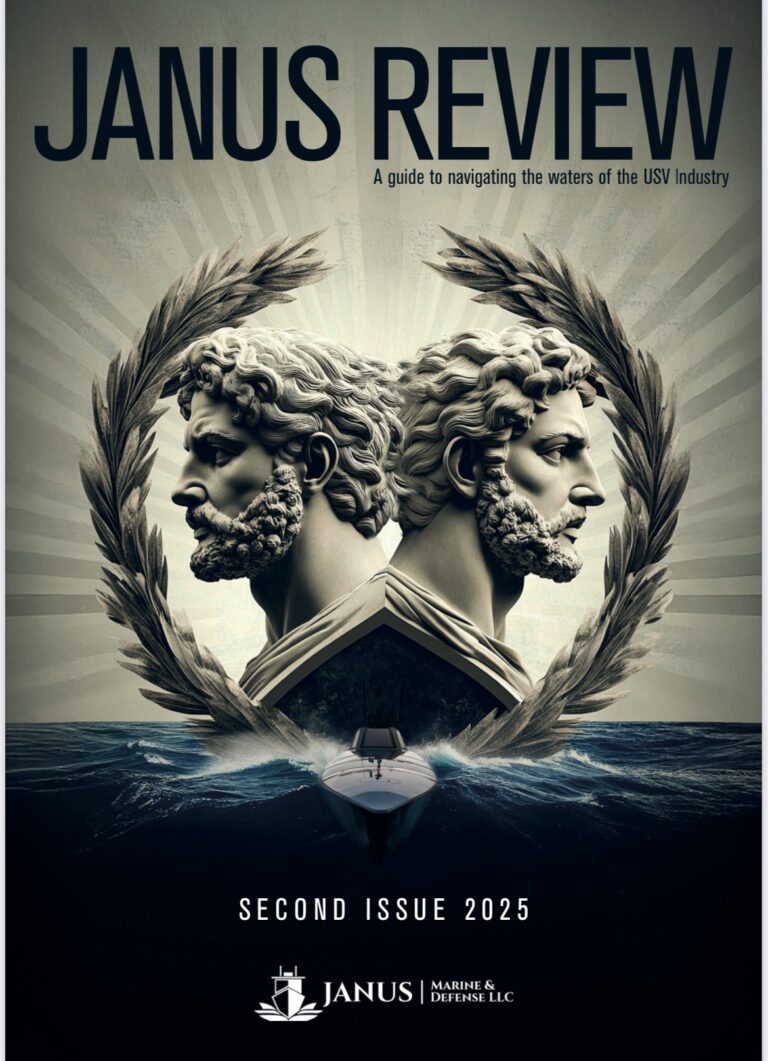
Major new report into uncrewed vessels highlights industry challenges
- The Janus Review into uncrewed vessels is now in its second year and will be launched at Sea Air Space exhibition April 6-9 in Maryland USA
- Reports reveals significant technological gaps are limiting widespread Unmanned Surface Vessel (USV) adoption
- Reluctance around intellectual property sharing, concerns about competitive advantages are preventing widespread collaboration
- The absence of agreed industry standards is a barrier to sector growth
- Finding the right talent for the industry remains a challenge
- Low volume production is keeping costs high and slowing innovation
Significant technological gaps are limiting the widespread adoption and full autonomy of Unmanned Surface Vessels (USVs), a major new industry report is set to reveal.
Reluctance around intellectual property sharing, concerns about competitive advantages, and the absence of agreed industry standards are preventing the widespread collaboration that is needed to overcome those issues, according to its authors.
Key technologies, including AI development, needed to move the sector forward are still under active research and finding the right talent for the USV industry also remains one of the biggest roadblocks to innovation and growth.
The 2025 Janus Review, which will be launched at the Sea, Air and Space Exhibition at National Harbor Maryland April 6-9, highlights key trends, addresses critical challenges, and showcases new applications and technologies that are shaping the USV sector.
Published annually by industry leader Janus Marine and Defense, a US-owned marine autonomy specialist, this year’s review says USVs have the potential to revolutionize maritime operations, from defense and security to offshore research and logistics.
It describes the sector as “an exciting and fast-evolving field”. However, report editor Janus Marine and Defense owner Jack Dougherty said it reveals that a number of key challenges are “standing in the way” of the industry reaching its full potential.
These include its continuing ‘Low Demand, Low Volume problem’, which the report’s authors say is having “significant consequences” in a number of areas.
Unlike industries with predictable consumer demand, USVs often cater to niche markets such as defense, offshore surveying, and research. This makes it difficult for manufacturers to justify large-scale production lines, “keeping costs high and innovation slow”.
Additionally, companies looking to break into the market face “significant challenges in funding and scaling operations”.
Jack said: “USV technology is at a crossroads. It is undoubtedly the future. But progress is slower than it should be. The reality is that developing a new USV requires heavy upfront investment in R&D, testing, and certification, costs that must be recouped over a small number of sales. Unlike automotive startups that can enter the market with well-established supply chains and contract manufacturers, USV companies often have to build their own infrastructure from the ground up, further increasing costs.
“Ultimately, the low-volume nature of the industry creates a cycle: high costs limit demand, limited demand discourages investment, and slow investment stifles technological progress. Until USVs become more widespread and production volumes increase, these challenges will continue to shape the industry’s growth.”
Jack added: “Many of the challenges facing USVs today aren’t about proving that autonomy works – it does. Instead, the real issues are about scalability, efficiency, and reliability.
“Whether it’s enabling intelligent fleet coordination, improving perception systems, or making USVs truly self-sufficient, there’s still a long way to go.”
The report looks at a number of key challenges facing the industry and examines what is needed to meet them. They include the need for open-source architectures, which the authors describe as ‘building blocks for innovation’.
The review highlights how every USV manufacturer currently creates proprietary command-and-control interfaces, “often reinventing the wheel” and leading to wasted effort, higher costs, and slower innovation cycles.
It says operators feel constrained by the lack of flexibility and interoperability among current systems.
The report concludes: “If there was an open-source UI and standardized API for USVs, everyone would jump on board immediately. Modular autonomy components, easily assembled like Legos, would accelerate innovation, reduce development costs, and allow users to easily tailor their systems to specific mission needs.
“Industry reluctance around intellectual property sharing, concerns about competitive advantages, and the absence of agreed-upon standards have prevented widespread collaboration. Breaking through these barriers requires collective effort and agreement on common industry standards.”
Examining the industry’s recruitment challenges, the report states: “Finding the right talent for the USV industry isn’t just difficult, it’s one of the biggest roadblocks to innovation and growth.
“Unlike industries with deep talent pools, like automotive or aerospace, USVs sit at the intersection of multiple fields, making recruitment a constant challenge.
“Hiring for USVs isn’t just about filling positions, it’s about finding specialists who can bridge multiple disciplines and thrive in an industry that lacks the structure and predictability of more mature fields.”
Looking at some of the technical challenges facing the industry, the report says:
- Achieving truly adaptive navigation requires advanced modeling, real-time data integration, and sophisticated AI algorithms – still developing and largely unproven in maritime environments.
- Reliable marine computer vision systems require specialized datasets and algorithms tailored to challenging sea conditions, still under active development.
- Real-time sonar data processing and reliable AI classification of underwater obstacles remain significant technological hurdles, demanding continued research and testing.
- Intelligent self-diagnostics paired with adaptive mission-planning capabilities would revolutionize USV autonomy. Integrating real-time diagnostics with autonomous decision-making requires highly advanced algorithms and robust onboard computing, capabilities not yet fully matured or widely available.
- Acoustic sensing faces major challenges such as high ambient noise levels, complex signal processing requirements, and reliable integration into autonomy algorithm – all areas needing ongoing research and improvement.
To receive a copy of The Janus Review: Issue II (2025) visit: www.JanusDefense.com
The first 25 visitors at Sea Air and Space will receive a hard copy of the report for free.
Note to editors
Janus Marine and Defense was founded Jack Dougherty, a former US Navy seafarer with wide experience of naval and commercial marine autonomy.
In March 2025, with its partner Nexus Remote Solutions, it announced plans to open the UAE’s first center for the testing, hiring and maintenance of unmanned vessels.
