
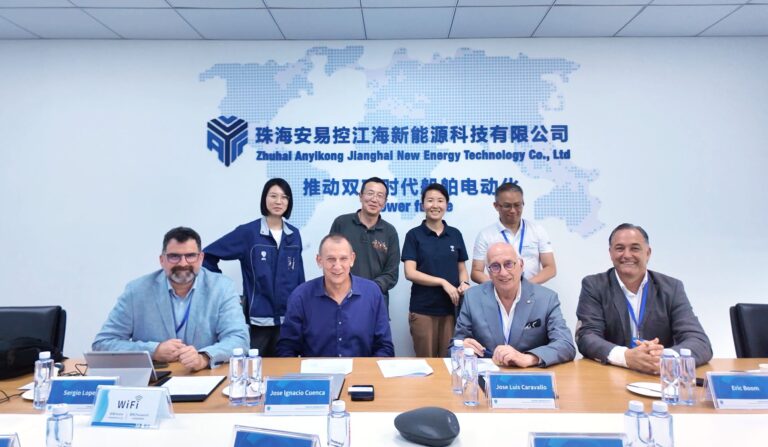
AYK Energy, the world’s fastest growing marine battery manufacturer, is further expanding electric propulsion systems in the chemical tanker market after signing a second deal with Spanish ship owner Mureloil.
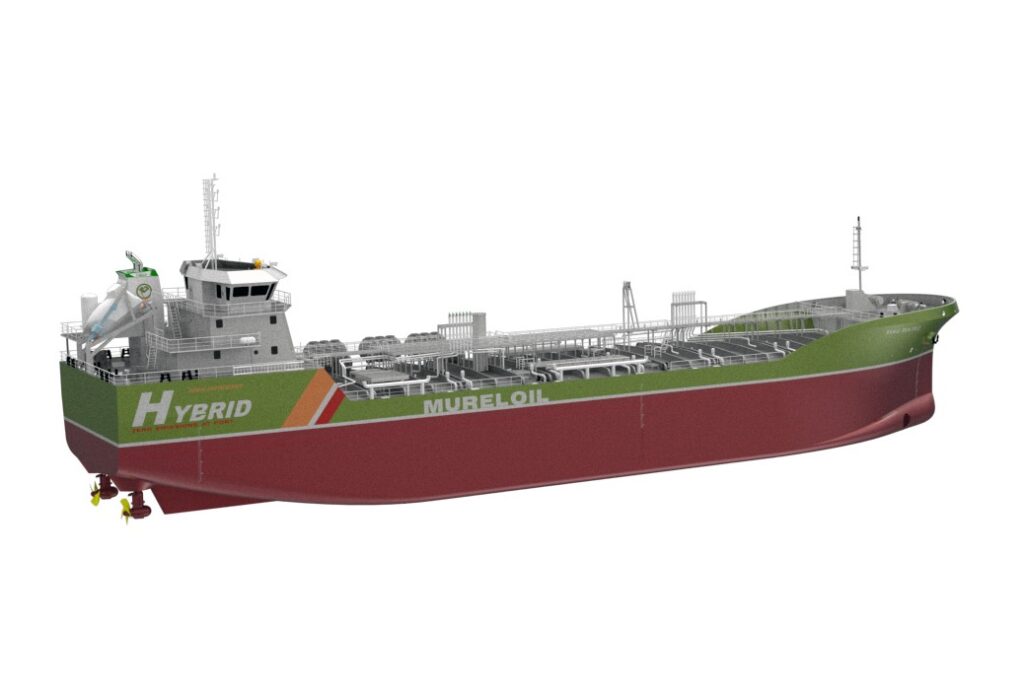
While installing battery systems in the ferry and workboat sector is well established, AYK is pioneering the use of diesel electric hybrid systems in the tanker market. As a result the two tankers being built by Mureloil will be among the first in the world to operate on diesel electric power enabling Mureloil to slash GHG emissions by up to 50 per cent. In port, meanwhile, emissions will be cut entirely as the vessels can operate on full electric power during port operations.
AYK Energy founder Chris Kruger said the latest deal was signed following a site visit at AYK’s Zhuhai, China factory. He said the agreement will see AYK deliver the same 4.2 MWh Aries+ battery system to Mureloil’s 8000 DWT product tanker Bahía Beatriz, currently under construction at Astilleros de Murueta shipyard, outside Bilbao. This follows successfully installing the battery system aboard its sister vessel the Bahía Candela, also a 8000 DWT tanker. The vessels will double Mureloil’s capacity to transport biofuels and methanol, strengthening the shipping line’s presence in the sustainable marine fuels sector.
Mr Kruger said the AYK team would like to thank Mureloil for trusting AYK to deliver a second system on its new vessel. And he confirmed AYK’s Spanish agent VULKAN will help install the battery system.
“The time for marine batteries has come,” he said. “Although these vessels are hybrid diesel electric we are now seeing that the technology is there to go fully electric not just on ferries, OSVs and workboats but also tankers like these. But seeing batteries on tankers is a significant moment for electric power. The energy density of batteries is increasing, the price is reducing and the payback period is quicker. AYK’s latest innovation with Mureloil sends a bold message that batteries are fundamental to maritime’s decarbonisation journey. Batteries are just getting bigger and better all the while slashing more emissions.”
Mr Kruger said the battery system will be made from high energy performing LFP (Lithium Iron Phosphate) technology which AYK is proving can outperform Nickel Manganese Cobalt (NMC) batteries.
“NMC has been the most commonly used battery chemistry because of its supposed greater density, but its chemistry is known to be much more dangerous than LFP,” he said. “AYK is showing that LFP can outperform NMC and deliver greater energy density, higher safety and better value.”
The latest deal with Mureloil is further recognition of AYK’s product leadership and a continuation of AYK’s rapid year over year growth. Over the summer AYK Energy announced a major milestone when its latest range of marine batteries received type approval from DNV (see notes to editors 1). Mr Kruger said the approval set new standards democratising marine battery technology.
Mr Kruger said demand for battery power is further being fueled by mounting regulatory pressure on ship owners, who face greater scrutiny and penalties under new laws like FuelEU and EU Emissions Trading System (ETS – see notes to editors 2)
“The regulatory squeeze is real,” he said. “With the new sustainability reporting requirements, ship operators know they need affordable carbon cutting solutions like marine batteries that deliver.”
 ENDS
ENDS
Notes to editors
1) In June 2025 the classification society DNV, approved AYK Energy’s Pisces, Pisces +, OrionAN, OrionAN+ as well as aluminum versions of AYK legacy modules setting new standards in clean energy marine propulsion.
2) More ports like Rotterdam, Antwerp, LA, Long Beach and Singapore are now requiring low emission or zero emissions operations. While the European Union is targeting operators via the Emissions trading scheme (ETS), which issues fines and penalties if ships do not comply with emissions reporting and can even deny port access for repeated breaches. The EU is further running the FuelEU maritime programme which imposes limits on the carbon intensity of a ship’s energy and encourages use of green fuels.
Separately the International Maritime Organisation (IMO) has created the Net-zero Framework which is the first in the world to combine mandatory emissions limits and GHG pricing across an entire industry sector.
Approved by the Marine Environment Protection Committee during its 83rd session (MEPC 83) from 7 – 11 April 2025, the measures include a new fuel standard for ships and a global pricing mechanism for emissions.
These measures, set to be formally adopted in October 2025 before entry into force in 2027, will become mandatory for large ocean-going ships over 5000 gross tonnage, which emit 85 per cent of the total carbon dioxide (CO2) emissions from international shipping.
Under the draft regulations, ships will be required to comply with:
Global fuel standard: Ships must reduce, over time, their annual greenhouse gas fuel intensity (GFI) – that is, how much GHG is emitted for each unit of energy used. This is calculated using a well-to-wake approach.
Global economic measure: Ships emitting above GFI thresholds will have to acquire remedial units to balance its deficit emissions, while those using zero or near-zero GHG technologies will be eligible for financial rewards.