
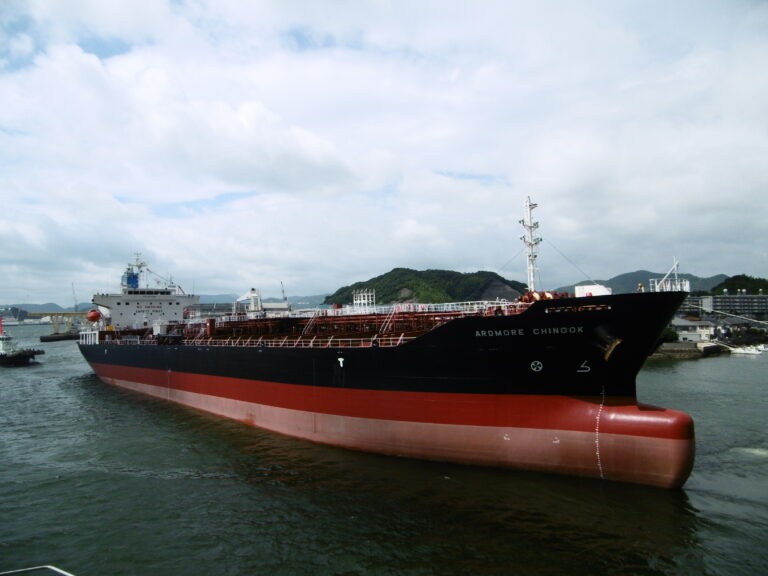
AVON, OHIO headquartered manufacturer Advanced Polymer Coatings (APC) has carried out a mid-life recoating programme on six Ardmore Shipping product and chemical tankers that is delivering large-scale operational advantages.
Mid-life recoating allows owners to reset coating condition, extend service life and fundamentally change a tanker’s trading capability – without the capital expenditure associated with a new fleet.
Ardmore’s vessels have been recoated with APC’s high-performance MarineLINE coating system and the Ireland-based tanker operator is now reaping the benefits of measurable gains in efficiency, emissions performance and trading flexibility.
The recoated mid-range tankers are all around ten years old and were originally delivered with epoxy-coated cargo tanks.
While such systems remain widely used, owners increasingly report constraints when trading aggressive cargoes such as methanol, free fatty acids (FFAs), vegetable oils and certain biofuels.
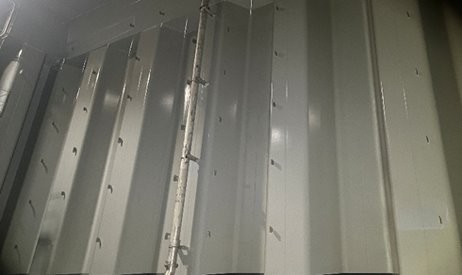
The APC recoating programme was carried out at Chengxi Shipyard in China. MarineLINE is a heat-cured polymer coating designed to form a tightly bonded, non-porous lining with exceptionally low permeability.
The recoated vessels are two South Korean-built 37,764 DWT D Class tankers: ARDMORE DEFENDER and ARDMORE DAUNTLESS, and four Japanese-built C Class vessels: the 25,217 DWT ARDMORE CHEYANNE, the 25,215 DWT ARDMORE CHEROKEE, the 25,233 DWT ARDMORE CHINOOK and the 25,211 DWT ARDMORE CHIPPEWA.
 Cristin Nutu, Cargo Manager at Ardmore Shipping, said: “This recoating strategy is about keeping our ships ready for what the market demands today. Speed, flexibility and the ability to handle challenging cargo sequences are critical to capturing favourable freight economics.
“We now have greater cargo versatility, as MarineLINE supports a wider range of chemicals, including demanding, high-specification grades.
“As a result, our fleet can pursue a broader set of backhaul cargoes and repositioning options, capturing favourable freight economics and reducing exposure to ‘ballast-only’ legs when market conditions shift.”
“Reduced cleaning times can also drive secondary benefits. We will use fewer chemicals and less water, along with shorter steaming, and port stays related to tank readiness will decrease workloads and the pressure on crew, lowering the total cost of operation across the cargo cycle.”
 Peter Stoyles, Global Marine Sales Manager at APC, says its growing order book of recoating projects are increasingly driven by operational barriers and loss of trade rather than coating age alone.
He said: “We are often brought in because existing coatings are struggling to cope with aggressive cargoes such as methanol and FFA. Owners have missed spot trades because cleaning and ventilation have taken too long, or they simply couldn’t prepare the tanks in time.”
At the core of the issue is surface absorption. To varying degrees, molecules can penetrate the coating structure of traditional epoxy coatings, driving longer cleaning cycles, ventilation times and higher energy consumption.
Stoyles added: “They can act like a sponge and this absorption directly reduces a vessel’s availability for spot market trading.”
MarineLINE’s technical differentiation lies in the density of its cured polymer surface. Heat curing creates a tightly knitted molecular structure comprising up to 784 cross-links, forming a chemically inert barrier. In APC studies, MarineLINE has demonstrated resistance to more than 5,000 chemical products.
Stoyles explained: “Once fully cured, the lining does not allow cargo molecules to permeate the surface.”
The operational impact of reduced absorption is most clearly seen during cleaning. APC estimates that a chemical tanker with premium epoxy-coated tanks carrying methanol, for example, may require seven to ten days for cleaning and ventilation before its next cargo. With MarineLINE, this can be reduced to approximately three days.
 Stoyles added: “When you extrapolate that across a year, or across a vessel’s lifetime, the financial and environmental implications are substantial.”
MarineLINE has been installed on approximately 700 vessels worldwide. In terms of lifetime performance, for high-specification chemicals, MarineLINE typically achieves a service life of seven to ten years, while in clean petroleum product trades some installations have exceeded 20 years.
According to APC’s operational modelling, a 25,000 DWT tanker fitted with MarineLINE can earn a considerable premium due to increased availability and cargo flexibility.
Stoyles said: “Operators trading in the spot market benefit from faster turnaround times. If you can clean quicker, ventilate faster and accept aggressive cargoes, you are simply more available to take that trade.”