
Udaipur’s position as one of India’s premier heritage and cultural destinations is being showcased in a new book.
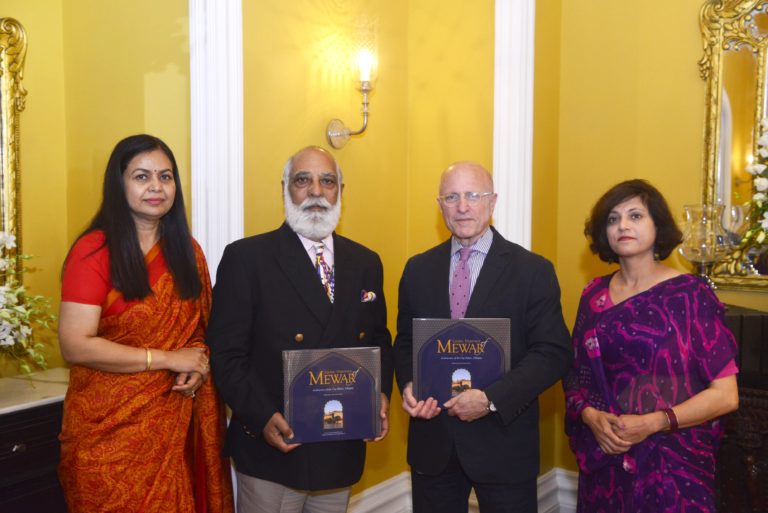
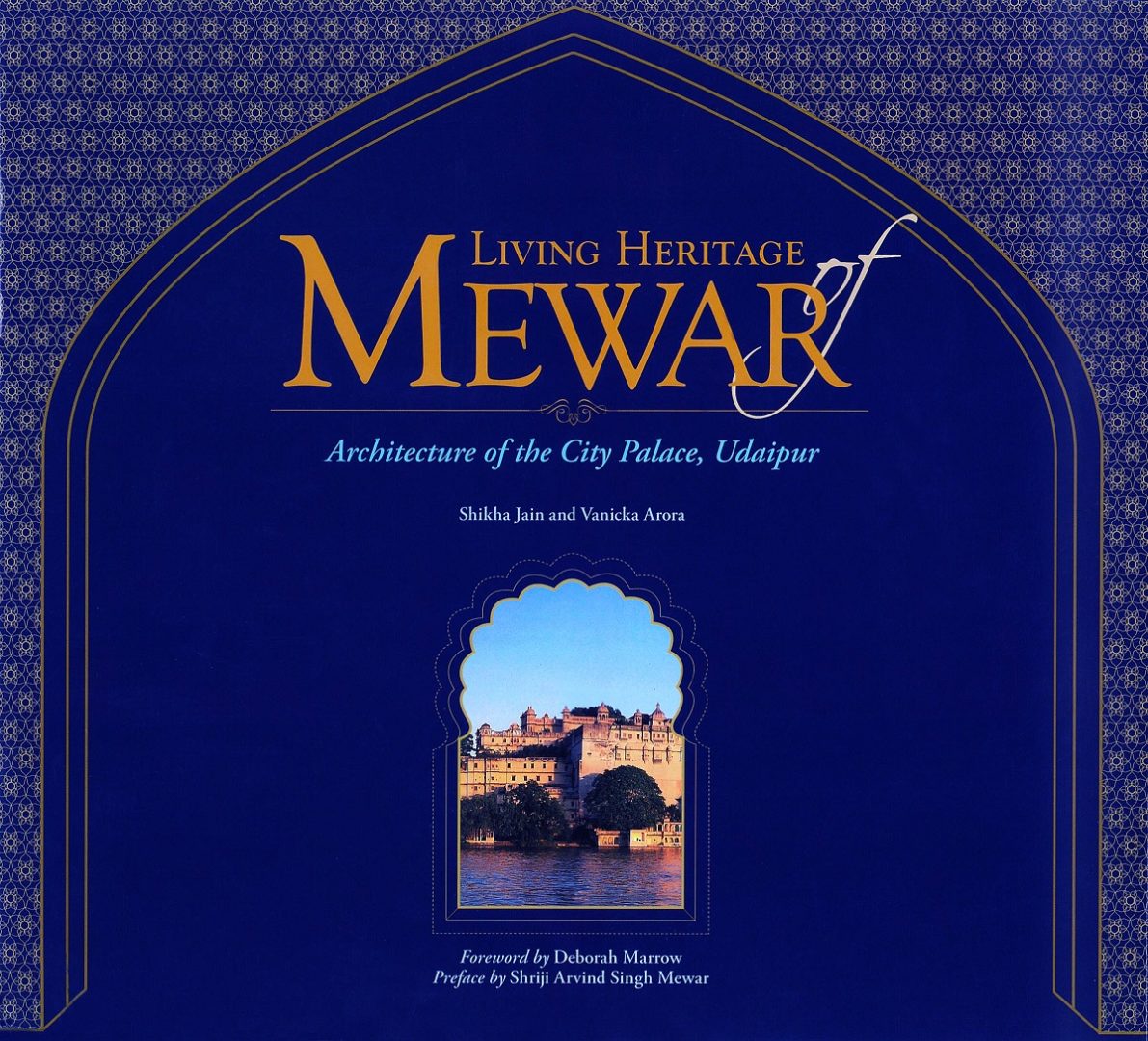
‘Living Heritage of Mewar: Architecture of the City Palace, Udaipur’ is out now after being launched at the Taj Mahal Palace, Mumbai by Dr James Cuno, President and CEO of the J Paul Getty Trust, in the presence of Shriji Arvind Singh Mewar, Chairman and Managing Trustee of the Maharana of Mewar Charitable Foundation (MMCF), Udaipur.
The book documents a major project, first started in 2005, funded with grants from Getty, to conserve the living heritage of Udaipur’s famous City Palace (see notes to editors). The 200,000 sq ft palace, which is now a museum, is one of the finest examples of combined Rajput and Mughal architecture in India and has been home to 23 successive Maharana’s of Mewar, the oldest royal serving dynasty in the world.
The foundation of the palace in 1559, and the city of Udaipur, was laid by Maharana Udai Singh I along the banks of Lake Pichola, which historians and environmentalists have hailed as a ‘strategic, sustainable and smart’ move.
The present Maharana, Shriji Arvind Singh Mewar, said the book launch marked a milestone in the redevelopment of the City Palace and thanked Getty for its guidance and support for the conservation planning led by Dr Shikha Jain.
“Our commitment to living heritage is complete,” he said. “By working with Getty we wanted to show art and heritage institutions worldwide and cultural travellers how serious we are about conservation. We have not just talked and let the masterplan gather dust on a shelf, we have put the plan into action with a huge amount of work over more than a decade. The history and culture of Mewar is vast and awesome and must be protected and championed. Udaipur, and the City Palace, capture the very best of India, and help tell the history of our country and our people. Our aim is to conserve this living heritage and catapult it out to India and the world. By managing living heritage properly, working with Getty and the United Nations, we will encourage visitors and investment from all over the world in Udaipur helping drive growth and job creation. We are merely custodians of Mewar and our job is to ensure Udaipur and the City Palace are in the best possible position to support future generations. That is at the very essence of this project, and the MMCF, and I want to thank Dr Jain for her formidable work.”
Shriji Arvind Singh Mewar said although more than 900,000 people visit the City Palace each year, Udaipur has huge untapped potential to build its standing as India’s prime heritage city.
“As this book shows we are on a journey to transform the City Palace and position it as ‘India’s Louvre’ celebrating iconic architecture, literature, music, arts, sculpture, paintings, education and spirituality,” he said. “The potential is limitless. I have been building on the platforms created by my late father, Maharana Bhagwat Singh Ji since 1984 and this book illustrates our journey supported by the Getty Foundation and the Ministry of Culture, Government of India.”
Dr Shikha Jain, who as well as leading the conservation masterplan wrote the new book, said it contains 165 photographs and 58 drawings and is an important resource for researchers, enthusiasts and travellers. (see notes to editors).
“The City Palace is an outstanding example of living cultural heritage that has survived in an unbroken line of custodianship from medieval kingship to modern democracy,” she said. “Our publication traces the history of the palace through its art and architecture to arrive at a conservation model to preserve this magnificent structure for the future. We have worked with a wide range of people from historians, to archaeologists to landscape architects to preserve not only the fabric of the building but also the stories of local people by recording their oral histories. We have studied the evolution of the palace, its inner and outer chambers and expansions, which shows innovative adaptations of Mughal and British period to suit original Mewar Rajput architecture. So far around 25pc of our plan is complete on ground so we still have some way to go. But if you look at our approach to the new silver and sculpture exhibitions, for example, you can see how carefully we are presenting the collections to the public.”
Getty Foundation director Dr Deborah Marrow, paid tribute to the conservation project and the importance of Mewar’s deep heritage.
“To preserve this jewel in India’s heritage crown for the future as well as manage the normal wear and tear of the site’s many visitors, its stewards recognized the need for a complete conservation plan,” she said. “The project developed by the MMCF aligned with the Getty Foundation’s dedication has advanced the practice of conservation through careful research and planning. Now a decade later, we are tremendously pleased with the outcome of the project, and it is rewarding to see the fruit of many years of hard work captured in this handsomely designed publication.”
Notes to editors
About the Publication
The initial section of the publication provides an overview of the exhaustive research and analysis of the palace architecture that was undertaken by the Maharana of Mewar Charitable Foundation during the preparation of its Conservation Master Plan with support of the Getty Foundation between 2005–2009, including a thorough study of art, architecture, landscape and built fabric within 57 palace spaces.
As part of the process, detailed archival research of the daily palace records known as bahidas and ekantars dating back to the 18th century was undertaken, along with a study of the various paintings and murals within the city palace which dated to various phases of evolution of the structures, going back to the 18th century. The architectural spaces, styles, structural innovations, planning principles, use patterns and layers of interventions for each phase were identified based on the archives, visual analysis and through comparisons with other structures in the Mewar region.
The different courtyards and their landscapes were analysed and recorded for the built open relationships within the palace. Additionally, traditional rituals, festivals and oral traditions were recorded in detail through texts, paintings and interviews. One of the key achievements of the first phase of planning was the compilation of an accurate set of documentation drawings for the palace, based on extensive topographical surveys and photogrammetry. The focus of this stage was on a multi-disciplinary approach to planning, with specific technical inputs from the various consultants. The conservation philosophy for the city palace, Udaipur goes beyond mere technical restoration, to encompass the social, cultural and the natural realms. It aims to conserve the built heritage in its entirety, along with its geographical and socio cultural morphology.
This conservation approach thus outlines conservation policies and prioritizes conservation activities that preserve and improve the identified values of the city palace by addressing both the tangible and the intangible heritage of the site in totality which constitutes the living heritage.
The concluding section of the publication offers an insight into the ongoing initiatives of the Maharana of Mewar Charitable Foundation in conservation and planning of these palace spaces and their conversion into a Living Heritage Museum of global significance. In 1969 Maharana Bhagwat Singh Mewar of Udaipur announced the formation of Maharana of Mewar Charitable Foundation and donated large portions of his City Palace Udaipur, along with an endowment to the Foundation. The City Palace thus became a Museum open to public, sustained by fees from visitors. Maharana Bhagwat Singh Mewar of Udaipur built platforms for future growth by creating charitable trusts. Education, community welfare, philanthropy and heritage preservation remained focus areas. He wanted to ensure not just the continuity and perpetuity of the House of Mewar but its core principle of governance through Custodianship. The City Palace Museum, Maharana Mewar Public School and Shri Vidyadan Trust are some of the enduring institutions that continue to flourish. In the 21st century these institutions directly employ over 2000; indirectly generating employment for 5000 families of the heritage-city. This informative and interesting book with a beautiful images of the city palace Udaipur is published by Mapin publishing, Ahemdabad with Maharana of Mewar Historical Publications Trust. Udaipur under the aegis of Maharana of Mewar Charitable Foundation.
About Dr Shika Jain
Dr. Shikha Jain has vast experience in cultural heritage of India that ranges from steering conservation projects for various state governments to preparing conservation management plans for international organizations such as the Getty Foundation, World Monuments Fund and UNESCO.
As Director, DRONAH, she has lead several conservation projects across India in last decade, including her most rigorous work on Conservation Master Plan works of the City Palace Museum at
Udaipur for the Maharana of Mewar Charitable Foundation. Ms. Vanicka Arora is an associate conservation architect with DRONAH and consultant on risk management with the National
Disaster Management Authority (NDMA). She is MSc in Conservation of Historic Buildings from the University of Bath, UK.
About Maharana of Mewar Charitable Foundation (MMCF)
‘Eternal Mewar’ was conceptualized in 2006 to provide an expression to the vision of the House of Mewar. Eternal Mewar underlined with the words ‘Custodianship Unbroken Since 734 AD’ expresses, embodies and encompasses the core values, principles and legacy of the House since centuries.
It covers all initiatives of the House of Mewar which as an institution is bridging a historic past with a volatile, uncertain future in the 21st century. Today, in the age of globalization, Eternal Mewar is no longer just an established heritage brand but essentially a vibrant catalyst which continues to sustain the living heritage of Mewar and the civilizational ethos of India.
The City Palace at Udaipur is a rare and exemplary living cultural heritage under Eternal Mewar.
Mewar background
- Mewar is the oldest serving dynasty in the world dating back to 734AD.
- The Maharana’s royal dynasty has immense religious importance to Hindus to the point where Maharanas have been seen as leaders of Hindus as well as all Rajputs. This dates back to their first great ruler Bappa Rawal, who was just three years old when the then ruler died in around 250 AD. Bappa met a holy sage Maarishi Harit Rashi who educated him in Hindu morality and taught him to recognise the local deityShri Eklingnath ,Ji a manifestation of Shiva. It is from this point that the Maharanas of Mewar have considered themselves to be earthly representatives of Shiva and whatever power they had was due to being appointed by Ekling Ji. For hundreds of years every Monday the Maharanas have made the pilgrimage to the beautiful temple of Ekling Ji, just half an hour from the Palace, to seek guidance and counsel. This is a key sight for culture tourists in Udaipur and an important place to grow understanding of the history of the Maharanas. The religious ethos is central to the story of Mewar. The Maharanas see it as their solemn duty to protect and serve the people of Mewar.
- Famous Maharanas include Kumbha (r. 1433-1468 AD) who built 32 fortresses including the UNESCO World Heritage site Kumbhalgarh likened by historian Brian Masters to seeing the Grand Canyon for the first time. Kumbhalgarh is 36 km long winding and second only to the Great Wall of China and contains 360 temples within the fort.
- The Mewar Dynasty’s ancient capital for 800 years was Chittor, around 70 miles from Udaipur. Today it is an abandoned ruin, national monument and UNESCO World Heritage Site. The Mughal emperor Akbar finally drove the people of Mewar from Chittor to Udaipur in 1567, a battle which saw 30,000 killed. The then Maharana Udai Singh I (r. 1537-1572 AD) established Udaipur in his name in 1559 as a refuse during the battles with the Mughals.
- Maharana Pratap (r. 1572-1597 AD), son of Udai, is one of the most famous Maharana’s known as a great warrior constantly fighting Akbar following the fall of Chittor until Akbar eventually gave up fighting Mewar. He won Akbar’s respect who is said to have cried when Pratap died. Udaipur’s airport is named in his honour: Maharana Pratap Airport.
- The future King Edward VII, when Prince of Wales, visited Udaipur in 1875. The Prince was given a dazzling sirpech sarpech (turban ornament) made of three large emeralds and bordered by bands of bright red enamel and diamonds by Maharana Sajjan Singh (r. 1874-1884) and will appear in the Royal Collection exhibition ‘Splendours of the Subcontinent: A Prince’s Tour of India 1875–76’ being held later in 2017 in Bradford and Leicester. See: https://www.royalcollection.org.uk/collection/11286/turban-ornament
- Mahrana Fateh Singh (r, 1884-1930) is one of most respected Maharanas and considered King George V ‘an equal at best’. At the Delhi durbar of 1911, one of the most grandiose spectacles in Indian history, attended by King George V, Fateh Singh insisted on meeting the King at Delhi Railway Station and refused to attend the durbar.
- Udaipur was visited during Prince of Wales 1921 tour with the future King Edward VIII saying: “There is nothing between Madras and the Northern Passes like Udaipur.”
- The City Palace has played host to visits by Queen Elizabeth II in 1961 Queen at Udaipur British Pathe and Jackie Onassis in 1962: British Pathe
- The City Palace and Udaipur were the settling for the James Bond film Octopussy in 1983.
The City Palace Museum background
The City Palace Museum comprises the Mardana Mahal, palace for the royal men, and The Zenana Mahal, palace for the royal ladies. Since 1969 these two palaces have been preserved and developed as The City Palace Museum, which is open to the public.
The Museum is in fact a series of palaces, built from the seventeenth to the twentieth centuries, spatially divided into royal private areas and public zones. Each of the palaces represents unique architectural styles and materials. Rare murals on the walls and ceilings, glass inlay work, original paintings and artefacts are spread over 20,000 square metres. Weaponry, armaments and personal belongings of the rulers are on display in their original places.
Palace courtyards such as the Mor Chowk with peacocks, exquisitely created with glass inlay adorning the walls; Chini Chitrashali with 18h century Dutch and Chinese tile-work; Krishan Vilas, Bhim Vilas, Chandra Mahal and the palace garden of Baadi Mahal at the highest point of the ridge are the most frequently visited.
The Museum houses an incomparable collection of court paintings of the Mewar School that flourished from the seventeenth to the twentieth centuries. These rare paintings are displayed in the Dilkushal Mahal, Baadi Mahal and the west wing of the Zenana Mahal.
Visitors can experience the architectural spaces and see breath taking views of Udaipur, the island-palaces on Lake Pichola and the mountains beyond. An optional Audio Service Guide (in English, German, French and Spanish) makes the museum tour memorable and filled with anecdotes.
Over the last five centuries, the City Palace has been welcoming visitors to its palaces, celebrating ancient Indian festivals with pomp and dignity, marking influences of the 1500-year-old royal family with the people of Mewar and the world.
In 2016 three more galleries have been added with-out any extra charges.
The silver showcase at ‘Splendour of Silver’ celebrates the grandeur of Indian royal weddings with the exquisite ‘mandap’ to the daily rituals including royal transport. Several unique objects such as the ‘Ram Rewari’ and religious items from the collection will be shown here for the first time.
Symphony of Mewar, a royal collection of musical instruments is a tribute by Shriji to the Living Heritage of Mewar and is an insight into the musical instruments that once belonged to the Maharanas of Mewar and played by the renowned music artists. The 3rd gallery is Sculpture Gallery which marks the completion of yet another phase of The City Palace Museum’s revitalization, expansion and modernization in 2014.
Other activities in the City Palace Complex, Udaipur
Crystal Gallery
Housed in the Fateh Prakash Palace is the world-famous Crystal Gallery, the biggest of its kind in the world. The collection is spread across the upper-gallery of the glittering The Durbar Hall
Crystal Gallery has been hailed as probably the single largest private collection of crystal anywhere in the world. Maharana Sajjan Singh (r. 1874-1884 AD) ordered the crystal collection from the Birmingham-based F&C Osler company. The collection includes a bewildering number of objects d’art, dinner sets, perfume bottles, decanters, glasses, washing bowls and even furniture. The Crystal Gallery also houses the only crystal bed in the world! The collection has been customised for the House of Mewar; the Crest of Mewar being delicately etched on the crystal, adding yet another amazing facet.
The Durbar Hall, which adorns the Fateh Prakash Palace, is of historical significance. In 1909, Lord Minto the Viceroy of India, laid its foundation stone and, in his honour, the hall was originally called Minto Hall. Its interior contains huge chandeliers and special lights, portraits of the Maharanas of Mewar, royal artefacts and the legendary armoury of the Mewar dynasty. The audio guide narrates the history and anecdotes about how the present Maharana, designed the gallery and how the crystal was unpacked after it had been in crates for over half a century.
The Vintage and Classic Car Collection
The Vintage and Classic Car Collection is a landmark in the city of Udaipur since it was inaugurated in February 2000. The grand limousines and cars showcased in the collection belong to the House of Mewar and are still in running condition. Visitors are privy to the display of the magnificent Rolls-Royce, 1939 Cadillac open convertibles, rare Mercedes models, 1936 Vauxhall and 1937 Opel models. The collection is housed in the original Palace Garage creating a pleasant hideaway from the bustle of the streets. One of the original Burmah Shell petrol pumps is not only still standing, but also in a usable condition. The garage was built at a time when the only cars in town belonged to the Royal Family. The bougainvillea-coated Garden Hotel and Restaurant, a Royal Retreat of HRH Group of Hotels is also housed within the elegant complex. The Garden Hotel derives its name from the near-by sprawling Sajjan Bagh gardens.
The Vintage & Classic Car Collection is a car collection with a difference including Ceremonial cars, Zenana cars and Sports cars. This collection allowed visitors to appreciate this prestigious collection of vintage cars for the first time in the year 2000. All the vehicles on show have belonged to the Maharanas of Mewar both past and present. Despite some vehicles being over 90 years old, each one has been painstakingly restored so that they are in working order.
Internationally famed James Bond film ‘Octopussy’ was shot in Udaipur in 1982-83 and The Rolls Royce 40-50 HP “Phantom II” Model -1934 Chassis No.181 RY Coach work by Windovers London was a part of the film.
1924 Rolls-Royce 20 hp, Barker Tourer (GLK 21) winner of Best of Class Category, Vintage Classic in the Cartier Travel with Style Concours in November 2008 held in Mumbai, India.
On the 19th August 2012, 1924 Rolls-Royce 20 hp, Barker Tourer (GLK 21), was awarded The Lucius Beebe Trophy at the 62nd edition of the Concours d’Elegance 2012 at Pebble Beach, California, USA.
Udaipur’s climate: Mild summers (30 degrees C to 40 degrees C); mild winters (11 degrees C to 28 degrees C). Clothing required: Light tropical in summer, carry hats and anti-sun lotions; Light woolen in winter. Accessories: Come armed with cameras and shoot to heart’s content in photographers’ paradise. Languages spoken: English, Hindi, Mewari. Best time to be there: September to April.
How to get there:
Nearest international airports: Ahmedabad, Jaipur, Delhi and Mumbai.
Flights: Daily flights from New Delhi (flight time: 1 hr. 10 mts.), Mumbai (1 hr. 30 mts), Ahmedabad (45 mts.), Jaipur (45 mts.).
Rail: Convenient daily trains from New Delhi, Mumbai, Ahmedabad and Jaipur.
Bus: Air-conditioned coaches to and from New Delhi, Mumbai, Ahmedabad and Jaipur.
Road: 637 km from Mumbai, 250 km from Ahmedabad, 405 km from Jaipur, 664 km from Delhi